Buy art at www.brucehoulder.art and support Fighting Knife Crime London








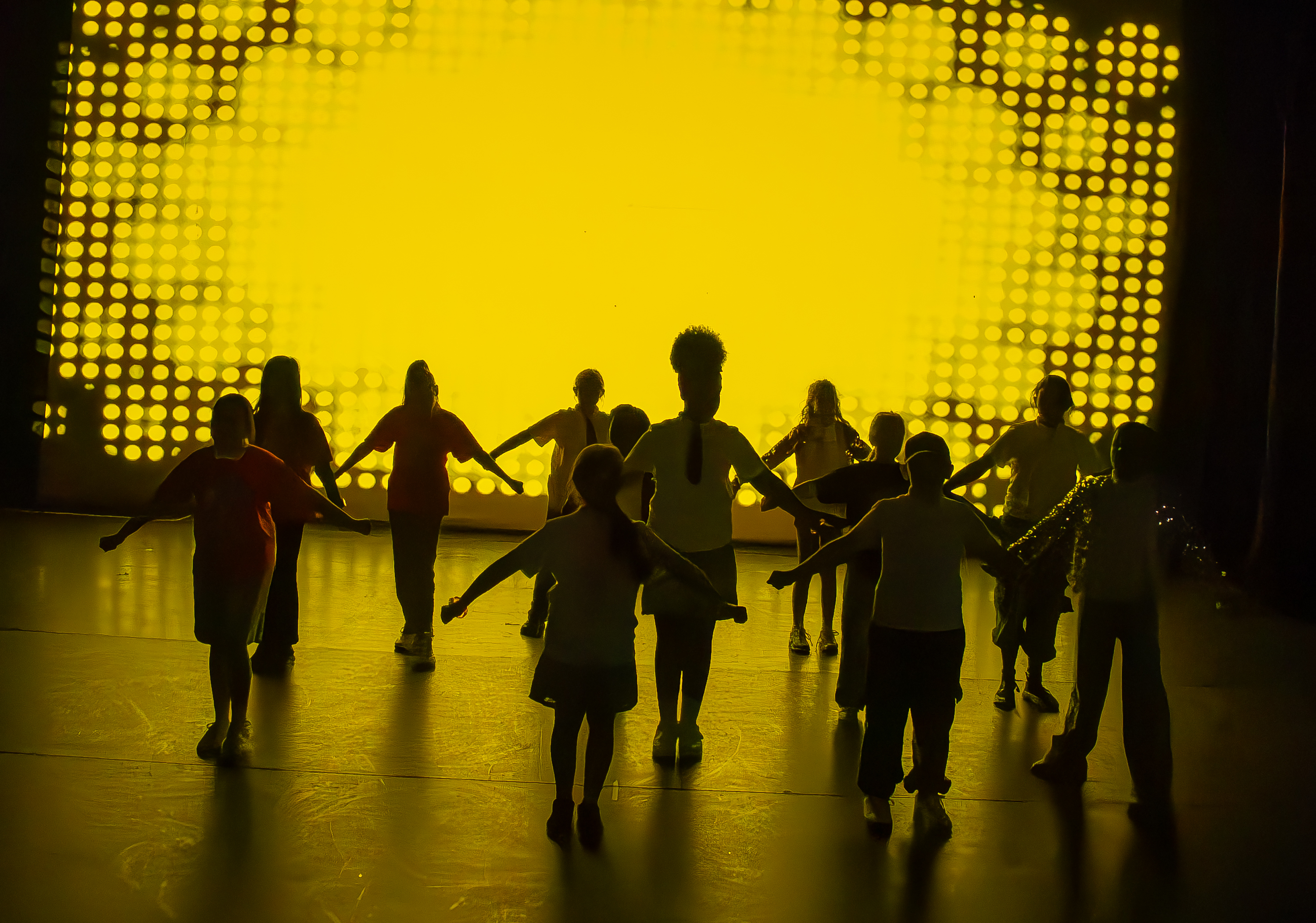
By Elizabeth Lahav, Founder and CEO, Streetz Ahead
Walking up to Mrs Miller's blue front door as a seven-year-old was something I dreaded every Wednesday evening after school. Although I had been desperate to start dance classes, this was not the dance or the space I was expecting. There was a strict set of rules: hair tied up in a bun, pointy toes and everything done in the right way. This was not me. I felt scared of making mistakes, scared of being shouted at and scared of getting it wrong. I did not feel safe in the very thing that was my absolute passion - dance.
Back in the 1980s, having divorced parents was taboo, but we were too busy having fun with our eccentric babysitters: a six-foot-five potter from St Lucia, who would blast loud music whilst we danced around the house, and our wonderful little Sarah from Russia, who would give us mountains of biscuits every night. I grew up with my siblings during the latchkey generation: roller-skating in the streets, making hideouts in the park and getting home by the time the streetlights came on. Despite potentially being denied stability by our parents, who were busy working abroad or studying with the Open University, we turned a blind eye to arguments and parties and focused on the thing we all loved - dance.
I continued searching for my dance, and when I was 14, I found Weekend Arts College, now Wac Arts. We could all wear what we wanted, and it was about being with people who had the same passion. Clubbing every weekend meant that dance entered my life in all aspects. My childhood reminded me that risk-taking can sit very close to a young person's search for excitement, identity and connection.
Where Streetz Ahead began
During my education and dance degree, I discovered the National Dance Institute in New York, where I shadowed its founder, Jacques d'Amboise during my third year. He took dance into some of the most challenging schools in the Bronx, Manhattan and New Jersey, working with children from homes and communities affected by poverty, instability and crime. For some of those children, dance was the only stable part of their lives. It gave them a moment of escape, and then the strength and courage to find a physical way through.
I knew this was my calling. When I asked if I could take the National Dance Institute to the UK, Jacques told me that I did not need him and that I could do this on my own. This is where Streetz Ahead began in 1995.
It started with six children I met at a summer camp in Tottenham and grew to 200 children a year as we continued taking street dance into schools. Back then, there were few after school clubs and virtually no dance clubs especially for boys. My husband and I taught every class, mixed all the music, set up the performances in local halls, presented the shows and then cleaned up at the end. We did everything we could to keep the cost down because, in our minds, dance was not a luxury; it was necessary for living a healthy life.
Today, around 3,500 children experience a programme through Streetz Ahead. Since completing my master’s degree in ‘Dance Movement Psychotherapy’, we have developed more opportunities for children to become physically and mentally fit for life through dance, performance, mentoring and creative therapeutic work.
Early intervention and the tiny glimmer
When I read about the exceptional changemakers featured in Fighting Knife Crime London Magazine, I am in awe of the work people are doing to make a difference, often after experiencing life-changing trauma themselves. Their lived experience enables them to stand alongside young people whose own experiences may feel earth-shattering.
Through Streetz Ahead, we try to find the young people who have struggled, who find life challenging, who may not always be at the top of the class or who come from difficult backgrounds. Early intervention can strengthen the things that protect a young person: a safe place, a trusted adult, positive peers, a way to express emotion, a sense of achievement and a believable future.
Our programmes give children a pathway and role models who can believe in them. They give them something to hold on to while families may be trying to hold on to some kind of normality themselves amid sky-high bills and a never-ending list of challenges. Early intervention can give a child a safe space in which to experiment, learn and build trusted relationships with local people who may look like them and understand some of the difficulties they face.
We look for the tiny glimmer: an interest in music, movement, choreography, lighting, mentoring or helping a younger child. If somebody notices that glimmer and gives it oxygen, it can grow into confidence, commitment, skill and passion. It can become the beginning of a different pathway.
Behaviour is often a coping mechanism
Through our BASE programme - Body and Soul Education – an in school mental health provision - we work with children in primary school because this early intervention is critical in giving them the vocabulary to articulate and understand their emotions. If a child understands why their throat feels blocked, their stomach is in knots or their legs are shaky; why they pull out their hair, pick at their skin, wet the bed, shout out or punch, they have a better chance of asking for help.
These signs can be a cry for help. It is not always about a child misbehaving, and I dislike the term 'attention seeker'. Perhaps the child needs attention; perhaps the behaviour is the only way they currently know how to communicate that need. Defences are coping mechanisms. A child who denies kicking somebody, even when a teacher saw it happen, may not be able to manage the stress of owning up in that moment.
Denial can feel easier to survive than the shame or fear of what might follow.
When we are under intense stress, our nervous system prioritises survival. The reflective and decision-making functions associated with the prefrontal cortex can become harder to access, while threat responses take over. We may fight, flee, freeze or try to appease. This happens at every age. A rational response is more likely when we have first been helped to calm down and the stress response has had time to settle.
This does not mean removing boundaries or excusing harm. It means learning to hold a boundary without using blame, shame or humiliation. If we can be present with primary-school children, teach them to articulate their needs and train staff to use compassionate communication, we make reflection, responsibility and repair more possible.
As children become teenagers and adults, rigid defences can become damaging. Projection may mean placing feelings we cannot bear in ourselves onto somebody else. Displacement can send anger towards a safer target. Regression can take us back to earlier ways of coping; avoidance and withdrawal can keep painful feelings out of sight; rationalisation can help us explain away behaviour rather than face it. These defences may protect us briefly, but if they become our only response, they can damage relationships, stop us taking responsibility and leave the original pain untouched.
When words are too difficult
During lockdown, when everything paused, I found myself needing to take a moment to go back into education and study for a master's degree. Dance Movement Psychotherapy meant that I could begin to make the crucial link between the body and mind. It has given me and Streetz Ahead a new direction in how I lead my company, with knowledge and understanding. I run weekly supervision with our mentors and therapists, giving us time to pay attention to what the body is communicating when words are difficult to find. ADMP UK describes the work as offering "opportunities for expression and communication through movement, particularly when words are difficult to find." That is exactly what I have seen. A child may not be able to say, "I feel powerless," but their body may become very small, remain at the edge of the room or move with explosive force to show an inner aggression they cannot put into words. I will always remember the moment I entered a classroom after hearing a teacher exploding at a class of children. When I sat with the children in a circle, I asked them to freeze in their positions and then notice their shoulders; every child had raised, tense shoulders. During the check-in, I asked them either to say how they were feeling or to show me. One girl lifted her hand and showed us her palm, then stroked it with her other hand as if she were attempting to soothe herself. It was so powerful that she was able to show that she was hurting inside and needed comfort.
Movement can give that child a safe way to experiment. They can take up space, lead, stop, follow, set a boundary, be seen or move in rhythm with somebody else. A meta-analysis of 41 controlled studies involving 2,374 participants found that Dance Movement Therapy and dance interventions were associated with improvements across a range of psychological outcomes. The researchers reported promising evidence relating to depression, anxiety, quality of life, interpersonal skills and cognition, while also recognising differences and limitations across the studies. Creative work is not a replacement for specialist mental-health support, but it can be a powerful part of prevention, expression and recovery.
The psychoanalyst Donald Winnicott wrote: "It is in playing and only in playing that the individual child or adult is able to be creative..."¹ Dance, play and imagination give children somewhere to rehearse life: to experience trust, frustration, cooperation, agency, recovery and the courage to be seen.
Writing theatre so children can see difficult stories play out
This is also why I write theatre. I want schools to be able to bring children into a professional theatre at an early-intervention stage and let them experience the magic and power of a story playing out in front of them. On stage, we can explore subjects that we often avoid in everyday life - including grief and loss - without telling a child what they should feel. They can recognise something of themselves, watch another person find a way through and begin a conversation when they are ready.
Jade and the Beanstalk is a professional children's hip-hop theatre production that I have written for Streetz Ahead. Inspired by Jack and the Beanstalk, it follows Jade, a girl with a huge imagination who lost her mother when she was very young. Jade tries to process her grief through the stories she creates, while her hardworking father, a tailor, struggles to understand what is real and what is another one of her adventures.
Through hip hop dance, narration, animation and an original hip-hop soundtrack, Jade's imaginary worlds reveal the real feelings underneath them. The production explores grief, love, resilience and hope, showing how imagination and the arts can help us express and move through experiences that may otherwise feel impossible to name. It is not suggesting that everybody grieves in the same way. It is opening a difficult conversation and giving children a safe, embodied and memorable way into it.
Jade and the Beanstalk will be performed at Bernie Grant Arts Centre, Tottenham, from 14 to 16 October 2026. School bookings include a follow-up mental-health workshop. Tickets are £5 and £10. School booking form: https://docs.google.com/forms/d/e/1FAIpQLSfiNKcQ-BnASIQS3FS-ZFVz05O64UAMMXVK8y2BMbWusQRxg/viewform
Keeping young people connected
My love of dance gave me a chance to feel connected; it was, in essence, a sort of defence mechanism that helped me cope with growing up between two families. Dance was the part of my life where I could escape, be myself and build the essential tools that kept me from wandering too far away. I was lucky to find this escape, which helped me to cope while growing up, and my aim has always been to work with young people through dance, mentoring, creative therapies and theatre, giving them opportunities to discover their passion, what makes them light up inside and what makes them feel important. I want them to have the space to discover what makes them tick and what makes them feel whole, away from the pressures of social media, which can sometimes become another way of avoiding suffering or feelings that are difficult to face.
A dance class cannot change every circumstance around a child. Mentoring cannot remove poverty, bereavement or family conflict, and no creative programme can carry the responsibility for preventing knife crime on its own. But a consistent space, a trusted relationship and the chance to create rather than destroy can matter enormously.
Hope does not always arrive as something dramatic. Sometimes it is a child giving eye contact for the first time, a child returning the following week or somebody brave enough to step onto a stage. Our job is to notice that tiny glimmer, protect it and keep giving it oxygen until the young person can recognise the light as their own.
References:
[1] Association for Dance Movement Psychotherapy UK. What is Dance Movement Psychotherapy? https://www.admp.org.uk/dmp/what-is-dance-movement-psychotherapy
[2] Koch, S. C., et al. (2019). Effects of Dance Movement Therapy and Dance on Health-Related Psychological Outcomes: A Meta-Analysis Update. https://doi.org/10.3389/fpsyg.2019.01806
[3] Center on the Developing Child at Harvard University. Toxic Stress. https://developingchild.harvard.edu/key-concept/toxic-stress/
[4] 1 Winnicott, D. W. (1971). Playing and Reality, Chapter 4, "Playing: Creative Activity and the Search for the Self," p. 54. Tavistock Publications. https://www.routledge.com/Playing-and-Reality/Winnicott/p/book/9780415345460
Elizabeth Lahav is the founder and CEO of Streetz Ahead, a registered charity established in Tottenham in 1995. She is a Dance Movement Psychotherapist with a professional background in teaching, learning mentoring and creative youth work. Streetz Ahead advances the education and development of young people through dance and performance, alongside mentoring and creative therapeutic approaches.