Buy art at www.brucehoulder.art and support Fighting Knife Crime London








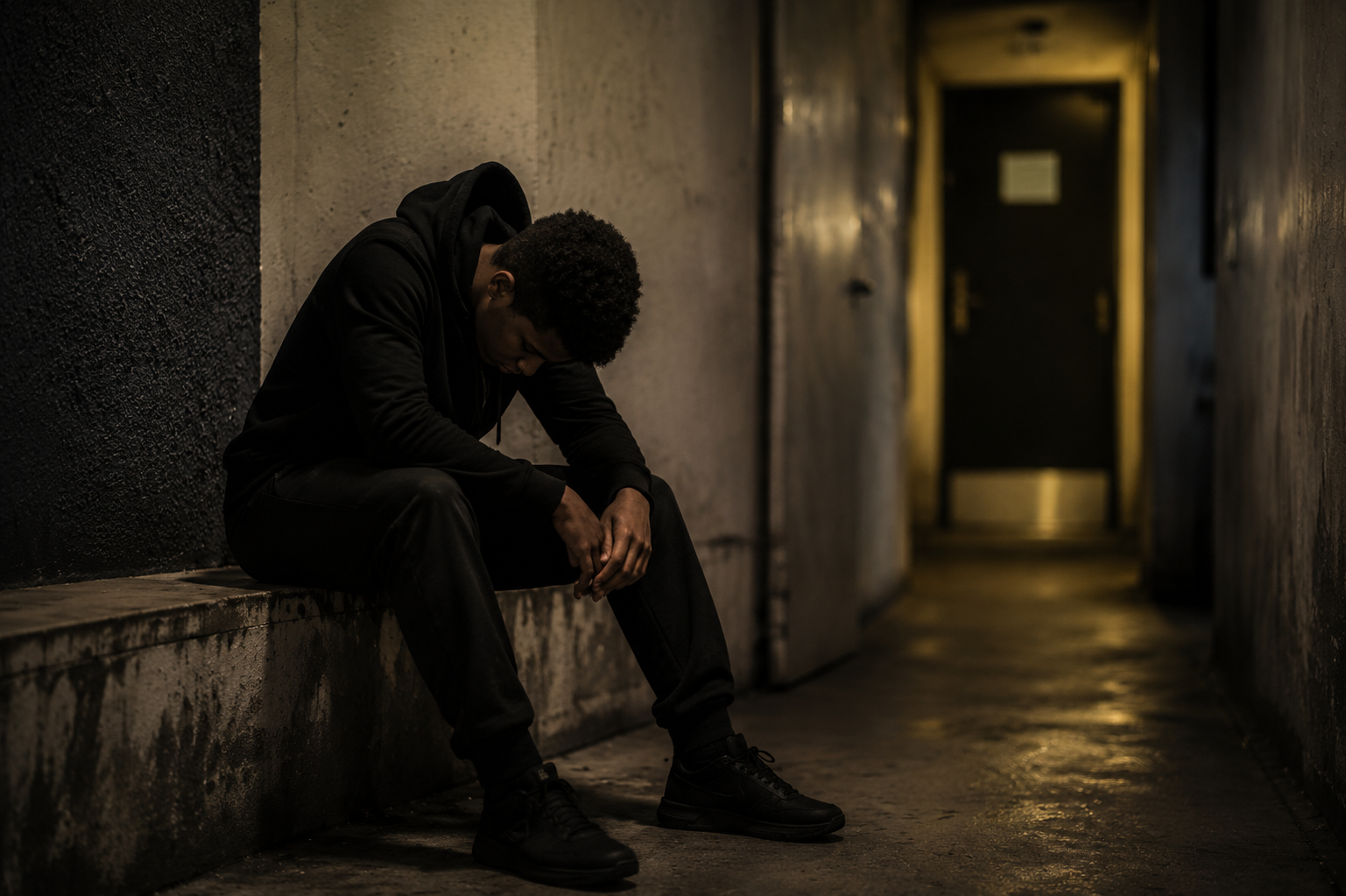
By Sheldon Thomas
Stood in a dancehall with a gun pointed towards me.
I watched a young man die beside me.
I have attended more funerals than I care to remember.
I have sat in government offices discussing knife crime and stood on housing estates living the reality of it.
I have worked with gangs, prisons, schools, governments and communities for more than three decades.
But perhaps more importantly, I have spent much of that time asking a question many people never ask:
What happened to the child before he became the offender?
Because after studying thousands of young people involved in gangs, violence and serious offending, I have come to one uncomfortable conclusion:
The knife is rarely the beginning of the story.
The crime is rarely the beginning of the story.
The gang is rarely the beginning of the story.
The real story often starts years earlier in childhood.
Long before the police become involved.
Long before a teacher raises concerns.
Long before a social worker opens a case file.
Long before a young person carries a knife.
My work has taught me that if we truly want to understand criminal behaviour, we must first understand trauma, attachment, abandonment, rejection, identity and belonging.
In other words, we must understand the child before we judge the adult.
The criminal mind does not develop in isolation.
It develops within families, communities, schools, friendships and environments.
That does not remove personal responsibility.
But it does help explain how some young people arrive at decisions that many of us struggle to understand.
The knife is often visible.
The trauma is not.
The violence is visible.
The abandonment is not.
The crime is visible.
The psychological wound beneath it often remains hidden.
Most public discussions focus on the act itself the stabbing, the arrest, the court case, the prison sentence.
My experience has led me to a different conclusion.
Knife crime is the visible outcome of a complex interaction between childhood trauma, attachment disruption, identity formation, fatherlessness, social influence, community breakdown and the search for belonging.
In other words, by the time a young person picks up a knife, the real damage has often already been done.
The Wound Before The Weapon
When a building collapses, investigators do not begin with the rubble.
They ask:
What weakened the foundations?
What warning signs were ignored?
What cracks appeared years before the collapse?
Knife crime is no different.
Many of the young people I have worked with over the years did not begin their journey carrying a knife. They began it carrying rejection, abandonment, fear, neglect, trauma and emotional wounds they did not have the language to describe.
Attachment Theory, developed by psychologist John Bowlby, teaches us that children need consistent love, protection, guidance and emotional security. These are not luxuries. They are necessities.
When those needs are repeatedly unmet, many children develop insecurity, mistrust, hyper-vigilance and emotional dysregulation.
In simple terms, they learn that the world is not safe.
A frightened child eventually becomes a frightened teenager.
And frightened teenagers often make dangerous decisions.
The Father and Parenting Factor
There is an elephant in the room that many people are reluctant to discuss.
Father absence.
This is not an attack on single mothers, many of whom perform heroic work raising children under incredibly difficult circumstances.
But we cannot ignore reality.
Research consistently shows that father absence is significantly overrepresented among young offenders and prison populations.
A father provides more than income.
He provides identity.
He provides boundaries.
He provides affirmation.
He provides protection.
He provides an example of manhood.
Many simply said:
"My dad wasn't there."
The street is always willing to adopt abandoned boys.
It simply demands a terrible price in return.
Throughout my work in prisons, youth offending teams, schools and communities, I have met countless young men who could describe in detail the gang leader who influenced them but could not describe a meaningful relationship with their father.
Today many parents, particularly those raising children alone, describe feeling trapped between responsibility and authority.
They are held responsible for their child's behaviour, attendance, criminality and educational outcomes, yet many tell me they feel increasingly uncertain about how much authority they have to correct, discipline and guide their children.
Over several decades, successive governments have introduced important safeguarding measures designed to protect children from abuse. Few would argue against protecting vulnerable children. However, many parents believe an unintended consequence has been the gradual erosion of parental confidence and authority.
In communities across the country, I regularly hear parents say they are afraid that firm discipline could be misinterpreted, reported or challenged. Whether those fears are always justified is almost beside the point. The result is that many parents feel disempowered, unsupported and increasingly isolated in raising their children.
Children need love, but they also need boundaries.
They need affection, but they also need accountability.
They need freedom, but they also need guidance.
A society that undermines responsible parenting should not be surprised when some young people seek direction elsewhere.
When healthy authority retreats, unhealthy authority often steps forward.
The gang leader becomes the father figure.
The older criminal becomes the mentor.
The street becomes the teacher.
And the lessons learned there are often devastating.
Why Belonging Matters More Than We Think
Abraham Maslow explained decades ago that human beings have fundamental needs.
Before achievement comes safety.
Before success comes belonging.
Before ambition comes security.
Yet society often expects children to achieve academically while living in emotional chaos.
How can a child focus on GCSEs when he feels unsafe?
How can he think about university when he fears walking home?
How can he concentrate in a classroom when there is conflict, instability or trauma waiting for him outside the school gates?
Schools matter enormously.
But schools cannot replace families.
Teachers cannot repair years of emotional damage in a fifty-minute lesson.
When Adults Stop Leading, Children Look Elsewhere
Many teachers today face challenges unimaginable to previous generations.
Across the country, teachers report increasing levels of disruption, aggression and disrespect in classrooms.
Many feel unsupported.
Many feel overwhelmed.
Many entered the profession to educate children but now find themselves acting as counsellors, social workers, mediators and surrogate parents.
The reality is simple.
Children need adults to lead.
Healthy societies rely on parents, teachers, coaches, faith leaders and community elders working together to provide guidance, boundaries and accountability.
When those influences weaken, children do not stop searching for direction.
They simply look elsewhere.
Sometimes they find it in sport.
Sometimes they find it in music.
Too often they find it in gangs, criminal networks and social media influencers.
Social Media Is Raising A Generation
Previous generations were largely raised by parents, grandparents, teachers, pastors, coaches and community leaders.
Increasingly, today's children are being raised by algorithms.
Many young people now receive their understanding of success, status, masculinity and identity from social media platforms.
The problem is that algorithms do not reward wisdom.
They reward attention.
They reward controversy.
They reward image.
They reward materialism.
They reward outrage.
The result is a distorted version of reality where respect is confused with fear, influence is confused with wisdom and money is confused with purpose.
For many vulnerable young people, crime can appear more attractive than employment because social media constantly displays rewards while hiding consequences.
The Loss Of Faith And Moral Anchors
As a Caribbean man who has also worked extensively within Irish communities, I have witnessed profound cultural changes.
There was a time when many of our families were held together by faith.
Churches were not simply places of worship.
They were places of accountability.
Places of belonging.
Places of guidance.
Places where values were reinforced.
No community was perfect.
But there was a shared moral framework.
Today many of those foundations have weakened.
As faith has declined, many communities have struggled to replace the sense of purpose, accountability and identity it once provided.
In that vacuum, social media, celebrity culture and street culture have often become the new teachers.
The consequences are visible in communities across the country.
What The United Nations Understands
The United Nations Convention on the Rights of the Child recognises the family as the fundamental group unit of society and the natural environment for the growth and wellbeing of children.
That principle should not be controversial.
Children thrive when they experience love.
Children thrive when they experience stability.
Children thrive when they experience guidance.
Children thrive when they experience belonging.
If society wants safer streets, it must first build safer homes.
My Story
When I look back at my own journey, I realise something important.
I was not fearless.
I was wounded.
I was not searching for violence.
I was searching for belonging.
Like many young men, I wanted identity.
I wanted significance.
I wanted purpose.
The gang appeared to offer all three.
What ultimately changed my life was not fear.
It was not prison.
It was not punishment.
It was purpose.
It was faith.
It was encountering Jesus Christ and discovering that my value did not come from the streets, my reputation or the opinions of others.
It came from God.
The Real Solution
There is no single solution to knife crime.
Not more policing alone.
Not more prisons alone.
Not more legislation alone.
We need stronger families.
We need present fathers.
We need better support for mothers.
We need mentors.
We need youth workers.
We need coaches.
We need churches, community groups and positive role models.
We need earlier intervention.
We need belonging before gangs provide it.
Every young person carrying a knife was once a child carrying a dream.
Somewhere between those two moments, something went wrong.
We also need to have an honest conversation about the role of schools.
Teachers cannot be expected to educate effectively while simultaneously managing persistent disruption, aggression and behaviour that would not have been tolerated in previous generations.
The overwhelming majority of teachers enter the profession because they care about children and want to help them succeed. Yet many report feeling unsupported when dealing with serious behavioural issues in the classroom.
Respect for teachers should not be optional. It should be a cultural expectation.
Teachers need the authority, support and resources to create safe learning environments where the majority, of children who want to learn are not disadvantaged by the behaviour of a disruptive minority.
Discipline is not the enemy of young people. Properly applied, discipline is one of the greatest expressions of care. Boundaries create safety. Expectations create responsibility. Accountability helps prepare children for adulthood.
If we want safer streets tomorrow, we must ensure our classrooms are places of learning, respect and order today.
Rebuilding safer communities will require more than policing. It will require rebuilding the institutions that once helped shape character and create belonging: strong families, engaged fathers, supported mothers, respected teachers, community mentors, faith organisations and positive role models. When adults lead with love, boundaries and accountability, children flourish. When those structures weaken, gangs, criminal networks and social media influencers are often waiting to fill the vacuum.
"This is not another article about crime statistics. This is an article about understanding the psychological journey that takes a child from abandonment to violence."
If we continue to treat knife crime solely as a criminal justice problem, we will continue to miss the childhood experiences that often created the conditions for it to emerge.
Because the battle against knife crime does not begin on our streets.
It begins in our homes.
For more than three decades, Sheldon Thomas has worked with gang members, serious offenders, schools, prisons, governments and communities across the United Kingdom, the Caribbean, Africa and the United States.
Drawing on lived experience as a former gang leader, combined with extensive frontline practice, his work focuses on understanding the psychological, social, and environmental factors that contribute to criminal behaviour, gang involvement, and violence.
His approach examines the relationship between childhood trauma, attachment disruption, identity formation, family breakdown, belonging, adverse childhood experiences and offending behaviour.
He is also an AI Diagnostic Expert, specialising in identifying structural, governance and behavioural risks within organisations.